 Written by
 Primitive firecraft may feel ancient, but the process behind it is rooted in real science.
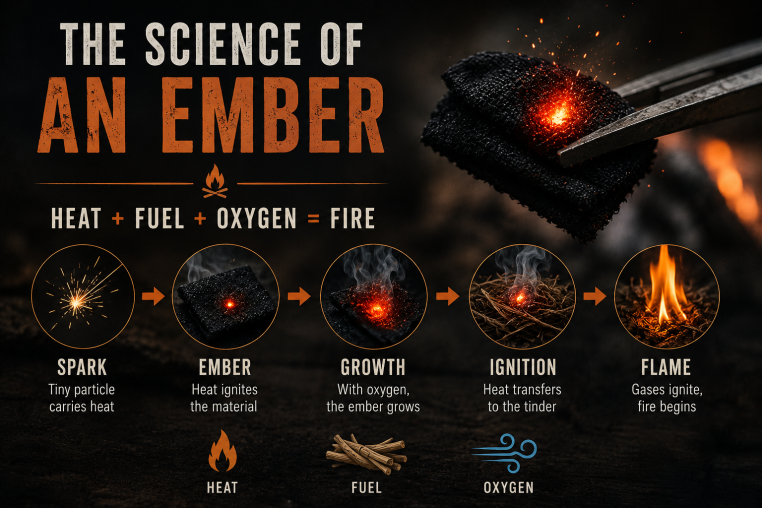
Every successful fire begins with the same chain reaction:
heat, fuel, oxygen, and ignition temperature.
Understanding how embers work helps explain why materials like char cloth are so effective.
What Is an Ember?
An ember is a slow-burning piece of material that glows from heat without producing an open flame.
Unlike a flame, an ember burns through oxidation occurring directly on the material’s surface.
In primitive firecraft, the ember is the critical bridge between spark and flame.
Why Sparks Create Embers
When using flint and steel or a ferro rod, tiny hot particles land on the char cloth.
If the material ignites at a low enough temperature, the spark transfers enough energy to begin combustion.
That tiny glowing point becomes the ember.
Why Char Cloth Works So Well
Char cloth works because it has already undergone carbonization.
Most moisture and volatile compounds have been removed, leaving behind carbon-rich material that ignites very easily.
That means:
- lower ignition temperature
- slower controlled burn
- better ember retention
The ember can spread slowly across the cloth while remaining stable long enough to transfer into tinder.
Oxygen and Ember Growth
An ember cannot survive without oxygen.
As air reaches the glowing material:
- oxidation increases
- heat spreads
- combustion strengthens
This is why gentle airflow is so important during primitive firecraft.
Too little oxygen kills the ember. Too much airflow cools or disrupts it before ignition occurs.
Why Tinder Bundles Matter
The tinder bundle acts as fuel for the growing ember.
Fine dry fibers increase:
- surface area
- oxygen exposure
- heat transfer
As the ember spreads into the tinder:
- smoke increases
- internal temperature rises
- ignition becomes possible
Eventually the heat reaches the point where flame appears.
Flame vs Ember
An ember and a flame are not the same thing.
Ember
Slow surface oxidation without visible flame.
Flame
Rapid combustion of gases released by heated fuel.
The ember creates enough heat to release combustible gases from the tinder. Once those gases ignite, flame appears.
Why Moisture Causes Failure
Water absorbs heat energy.
Instead of building temperature toward ignition, the ember wastes energy evaporating moisture.
That is why:
- damp tinder struggles
- wet char cloth fails
- dry material matters so much
Primitive firecraft depends heavily on proper preparation.
Primitive Firecraft and Physics
Despite its ancient roots, firecraft is still governed by modern scientific principles:
- heat transfer
- oxidation
- fuel chemistry
- airflow dynamics
The men who practiced primitive firecraft centuries ago may not have used scientific terms, but they understood the principles through experience.
One Spark Can Become Fire
Primitive firecraft proves how small energy can grow into something powerful.
A single spark becomes an ember.
The ember becomes flame.
The flame becomes fire.
That process has remained unchanged for thousands of years.
Tinderlight char cloth is proudly made in the USA by Knights Woodworks.
One spark is enough.